

Angeliki Xythali
| Title: | The role of European travelers and travel writers in promoting the geopolitical interests of the Great Powers in Greece and Cyprus during the 19th and 20th centuries |
| Position: | Ph.D Candidate |
| Email: | i05xytha@ionio.gr |
| Reg. Date: | 31-01-2023 |

- M. BOTSIS
- N. MYLONAS
- TH. PAPPAS
In both Greek and international scholarship, references to travel writing vary, while the significant activity of European travelers clearly emerges. This activity took multiple forms, including diplomatic missions aimed at defending Greek interests, journeys motivated by leisure and a love of nature, as well as literary pursuits, all of which brought Europe closer to the “idealized” space of Greece.The present study aims to examine the role of European travelers as political actors in the Greek region within the context of rivalries among the European Powers. It draws on an analysis of testimonies and travel accounts in order to reveal the underlying objectives of the political envoys of the period. Their missions in the Greek world highlight a different dimension of these journeys, particularly with regard to the roles assumed by travelers, with Greece as a central focal point. The figures examined in this study include the Bavarian Friedrich Thiersch, the Austrian Jakob Philipp Fallmerayer, and the British Lawrence George Durrell.
The study is grounded in the analysis of travel texts within the theoretical framework of the Geopolitics of Culture and systemic geopolitical analysis. In line with Neorealist theory, powerful states pursue expansionist policies by forming alliances with less powerful states in order to maximize their power and secure global hegemony.
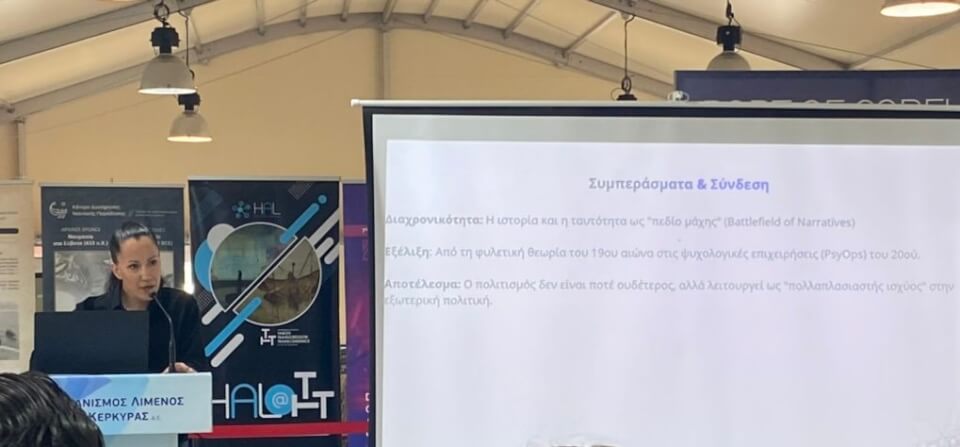
The findings indicate that European travelers and writers functioned not only as “philhellenes,” but also as informal political and diplomatic agents, contributing to the foreign policy objectives of the Great Powers. Society, institutions, traditions, and political practices operated within broader hegemonic frameworks that served the geopolitical interests of European Powers. This, in turn, created fertile ground for influencing public opinion and shaping dominant perceptions regarding “the benefits and gains of the stronger.”Finally, the study highlights the diachronic nature of this phenomenon during the period under examination, where history and identity constitute a “field of conflict,” while also providing a clear framework for understanding the evolution of these processes—from nineteenth-century theories to twentieth-century psychological operations. In this context, it becomes evident that culture is not neutral, but functions as a “force multiplier” in the foreign policy of states.
Back




SECRETARIAT
SECRETARIAT72 I. Theotoki str, 1st Floor
(+30) 26610 87960, 87961, 87962
dtour@ionio.gr